

Are volumetric flasks made of glass only?
Hey there! As a supplier of volumetric flasks, I often get asked this question: Are volumetric flasks made of glass only? Well, let's dive right into it and explore the different materials used in making volumetric flasks.
First off, glass has been the go - to material for volumetric flasks for a long time, and for good reasons. Glass is highly resistant to most chemicals. It doesn't react easily with acids, bases, or many organic solvents. This means that when you're using a glass volumetric flask to measure out a solution, you don't have to worry about the flask itself contaminating the solution or being corroded by it.
Also, glass is transparent. You can clearly see the meniscus of the liquid inside the flask, which is crucial for accurate volume measurement. When you're working in a lab, precision is key, and being able to precisely read the volume at the bottom of the meniscus is super important.
We offer a wide range of glass volumetric flasks. For instance, our Laboratory Large Graduated 1000ml 2000ml Glass Volumetric Flasks with Plastic Or Glass Stopper are great for larger - scale experiments. These flasks are made with high - quality glass that ensures accurate volume measurement. The option of having either a plastic or glass stopper gives you flexibility depending on your specific needs.
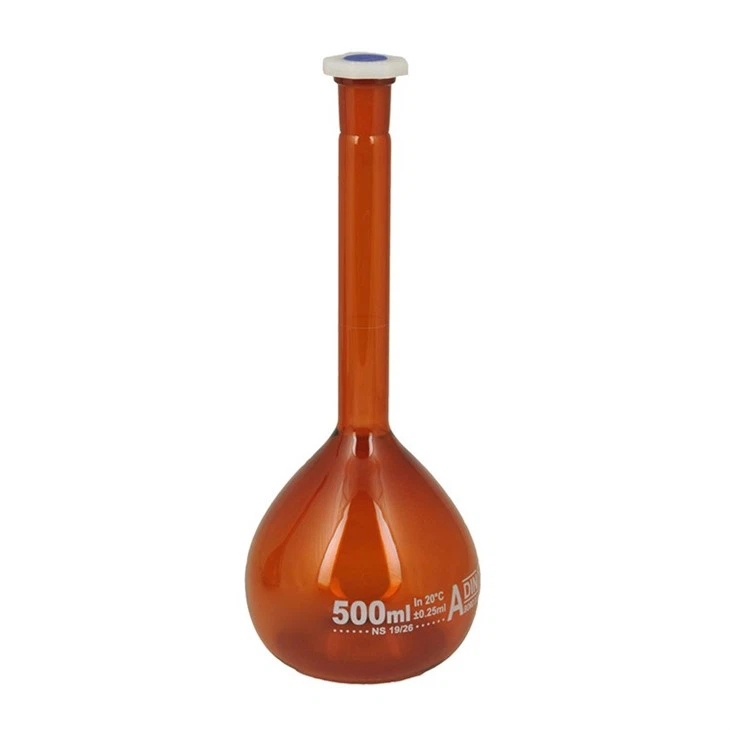

Another popular product in our glass volumetric flask line is the Lab 5ml 25ml 50ml Amber Glass Volumetric Flask with Stopper. The amber glass is specially designed for solutions that are sensitive to light. Some chemicals can break down or react when exposed to light, and the amber glass helps to protect them.
However, glass isn't the only material used for volumetric flasks. There are also volumetric flasks made of plastic. Plastic volumetric flasks have their own set of advantages. They are much lighter than glass flasks. This can be a big plus if you need to transport them around a lot or if you're working in a field where weight is a concern.
Plastic is also less likely to break compared to glass. In a busy lab environment, accidents can happen, and a dropped glass flask can shatter into pieces. A plastic flask, on the other hand, might just get a few scratches or dents.
But plastic does have its drawbacks. It's not as chemically resistant as glass. Some solvents can dissolve or react with plastic, which limits the types of solutions you can use in plastic volumetric flasks. Also, plastic isn't as transparent as glass in some cases, which can make it a bit more difficult to read the volume accurately.
There are also volumetric flasks made of other materials in some specialized applications. For example, in some high - pressure or high - temperature experiments, metal or ceramic volumetric flasks might be used. These materials can withstand extreme conditions that glass and plastic can't handle. However, these are not as common in everyday laboratory use.
When choosing between different materials for volumetric flasks, you need to consider your specific requirements. If you're working with aggressive chemicals, glass is probably your best bet. If you need something lightweight and less breakable, plastic might be more suitable. And if you're dealing with extreme conditions, you might have to look into metal or ceramic options.
So, to answer the question "Are volumetric flasks made of glass only?" - definitely not! There are multiple materials available, each with its own pros and cons.
If you're in the market for volumetric flasks, whether it's glass, plastic, or something else, we're here to help. We have a vast selection of products to meet your laboratory needs. Feel free to reach out to us to discuss your requirements and start a procurement conversation. We're committed to providing you with high - quality volumetric flasks at competitive prices.
References
- Laboratory Handbook on Glassware, various editions
- Chemical Safety and Material Compatibility Guides