

In the unique environment of the International Space Station (ISS), where microgravity reigns, the behavior of fluids and the functionality of common Earth - based tools undergo significant changes. As a Gravity Bottle supplier, I am often asked about how these bottles work in such an extraordinary setting.
Understanding the Basics of Gravity Bottles on Earth
Before delving into the microgravity scenario, let's first understand what a gravity bottle is and how it functions on Earth. A gravity bottle, also known as a pycnometer, is a specialized laboratory glassware used to measure the density or specific gravity of a liquid or a solid. The principle behind its operation is based on gravity. When a sample is placed inside the bottle, the liquid or solid displaces a certain volume of air. By accurately measuring the mass of the filled bottle and knowing the volume of the bottle, the density can be calculated using the formula: density = mass/volume.
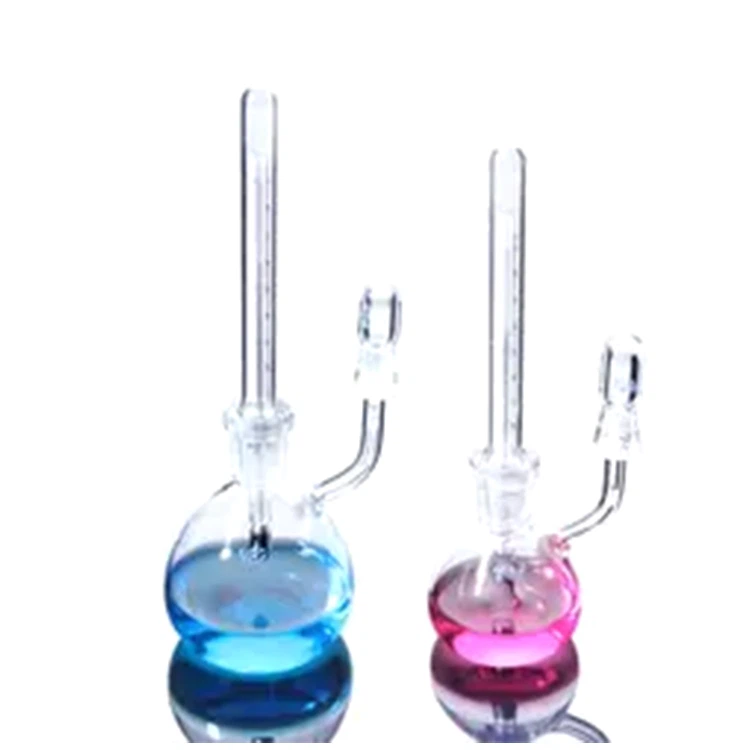
There are different types of gravity bottles available in the market for various applications. For example, the Lab Glass Gay Lussac 5ml 10ml 25ml 50ml Pycnometer Specific Gravity Bottle comes in different sizes, which allows for precise measurements according to the amount of sample. The Laboratory Glass 250ml 90mm Le Chatelier Chemical Specific Gravity Bottle is designed for specific chemical experiments where a larger volume and specific dimensions are required. And the High Borosilicate Glass Laboratory Pycnometer Specific Gravity Bottle with Thermometer is equipped with a thermometer, which is useful for taking temperature - corrected density measurements.
Challenges in a Microgravity Environment
On the ISS, the absence of a significant gravitational force presents several challenges to the normal operation of a gravity bottle. One of the primary issues is the behavior of fluids. In a microgravity environment, fluids do not flow in the same way as they do on Earth. Instead of being pulled down by gravity, they form spherical shapes due to surface tension. This means that when trying to fill a gravity bottle in space, the liquid may not settle at the bottom of the bottle as expected.
Another challenge is the measurement of mass. On Earth, we use the force of gravity to measure the mass of an object using a balance. In microgravity, traditional balance scales do not work because there is no gravitational force to act on the object. Therefore, alternative methods for measuring mass need to be employed, such as using an inertial balance, which measures the mass based on the object's inertia.
Adapting Gravity Bottles for Microgravity
To make gravity bottles work in a microgravity environment, several modifications and adaptations are necessary.
Fluid Handling
To ensure proper filling of the gravity bottle, special techniques are required to handle the fluid. One approach is to use capillary action. Capillary action is the ability of a liquid to flow in narrow spaces without the assistance of, or even in opposition to, external forces like gravity. By designing the opening of the gravity bottle to be very narrow, the liquid can be drawn into the bottle through capillary action. Another method is to use a syringe or a pump to carefully inject the liquid into the bottle, taking into account the behavior of the fluid in microgravity.
Mass Measurement
As mentioned earlier, traditional mass measurement methods are not applicable in microgravity. Inertial balance systems can be used in conjunction with the gravity bottle. An inertial balance works by oscillating the sample and measuring the period of oscillation. The period of oscillation is directly related to the mass of the sample. By measuring the period of oscillation of the gravity bottle with and without the sample, the mass of the sample can be determined.
Temperature Control
Temperature can have a significant effect on the density of a liquid or solid. In a microgravity environment, maintaining a stable temperature is crucial for accurate density measurements. The High Borosilicate Glass Laboratory Pycnometer Specific Gravity Bottle with Thermometer is particularly useful in this regard. The thermometer allows for real - time temperature monitoring, and additional insulation or heating/cooling systems can be used to keep the temperature constant.
Applications of Gravity Bottles in the ISS
Despite the challenges, gravity bottles have several important applications in the ISS.
Material Science
In the field of material science, the density of materials is a fundamental property. By using gravity bottles to measure the density of different materials in microgravity, scientists can study how the absence of gravity affects the structure and properties of materials. This research can lead to the development of new materials with improved properties for use in space and on Earth.
Biology and Life Sciences
In biological and life science experiments on the ISS, the density of biological fluids and samples can provide valuable information. For example, measuring the density of blood or cell cultures can help scientists understand the physiological changes that occur in a microgravity environment. This knowledge can be used to develop countermeasures to mitigate the negative effects of long - term spaceflight on human health.
Benefits of Our Gravity Bottles for Microgravity Research
As a Gravity Bottle supplier, we take pride in offering high - quality products that are suitable for use in microgravity environments. Our gravity bottles are made from high - quality glass materials, such as high borosilicate glass, which has excellent thermal and chemical resistance. This ensures the durability and accuracy of the bottles in the harsh conditions of space.
Our range of gravity bottles, including the Lab Glass Gay Lussac 5ml 10ml 25ml 50ml Pycnometer Specific Gravity Bottle, the Laboratory Glass 250ml 90mm Le Chatelier Chemical Specific Gravity Bottle, and the High Borosilicate Glass Laboratory Pycnometer Specific Gravity Bottle with Thermometer, provides options for a variety of research needs. Whether you need a small - volume bottle for a precise experiment or a larger one for a bulk sample, we have the right product for you.

Contact for Procurement and Discussion
If you are involved in microgravity research on the ISS or other space - related projects and are in need of high - quality gravity bottles, we encourage you to contact us. We are more than happy to discuss your specific requirements and provide you with detailed product information. Our team of experts is dedicated to helping you find the best solutions for your research needs.
References
- Long, D. R., & Seppelt, K. (2006). Handbook of Chemistry and Physics. CRC Press.
- Decher, G., & Schlenoff, J. B. (2003). Multilayer Thin Films: Sequential Assembly of Nanocomposite Materials. Wiley - VCH.
- Kays, W. M., Crawford, M. E., & Weigand, B. (2005). Convective Heat and Mass Transfer. McGraw - Hill.