

Dilution is a fundamental technique in various scientific fields, including chemistry, biology, and environmental science. A volumetric flask is a crucial piece of laboratory equipment designed to accurately prepare solutions of a specific volume and concentration. As a leading volumetric flask supplier, I'm here to guide you through the proper use of a volumetric flask for dilution, ensuring precision and reliability in your experiments.

Understanding the Volumetric Flask
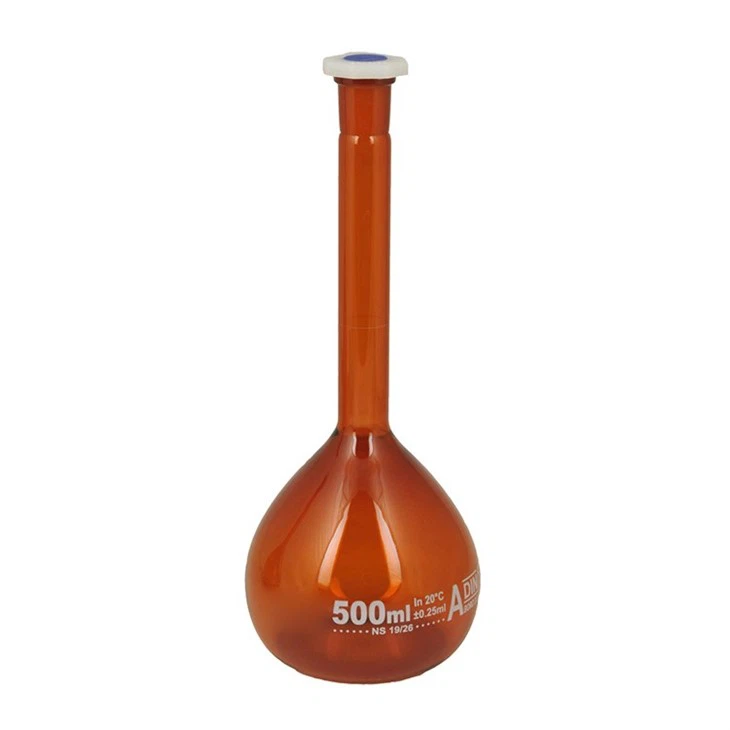
Before diving into the dilution process, it's essential to understand the design and function of a volumetric flask. Volumetric flasks come in various sizes, ranging from small 5ml flasks to large 2000ml flasks, each calibrated to contain a precise volume of liquid at a specific temperature, usually 20°C. They are typically made of glass, which is resistant to chemical corrosion and provides excellent clarity for accurate volume readings.
The neck of a volumetric flask is narrow and has a single calibration mark, indicating the exact volume the flask is designed to hold. This design minimizes errors in volume measurement, making volumetric flasks ideal for preparing solutions with high precision. Volumetric flasks also come with either a plastic or glass stopper to prevent evaporation and contamination of the solution.
Selecting the Right Volumetric Flask
The first step in using a volumetric flask for dilution is selecting the appropriate size flask for your needs. The size of the flask should be based on the volume of the final solution you want to prepare. For example, if you need to prepare 1000ml of a diluted solution, you should choose a 1000ml volumetric flask. Using a flask that is too small may result in overflow, while using a flask that is too large can lead to inaccurate volume measurements.
At our company, we offer a wide range of volumetric flasks to meet your specific requirements. Our Laboratory Large Graduated 1000ml 2000ml Glass Volumetric Flasks with Plastic Or Glass Stopper are perfect for preparing large volumes of solutions, while our Lab 5ml 25ml 50ml Amber Glass Volumetric Flask with Stopper are ideal for small-scale experiments or when working with light-sensitive substances.
Preparing the Volumetric Flask
Once you have selected the appropriate volumetric flask, it's important to prepare it properly before use. Start by thoroughly cleaning the flask with a suitable detergent and rinsing it several times with distilled water. This will remove any impurities or residues that could affect the accuracy of your solution.
After cleaning, dry the flask by allowing it to air dry or by using a clean, lint-free cloth. Avoid using heat to dry the flask, as this can cause the glass to expand and affect the calibration of the flask.
Measuring the Solute
The next step in the dilution process is measuring the solute, which is the substance you want to dissolve in the solvent to form a solution. Use a balance to accurately measure the mass of the solute, taking care to use the appropriate units (usually grams).
If the solute is a liquid, use a pipette or burette to measure the volume of the solute. Make sure to read the volume at the bottom of the meniscus, which is the curved surface of the liquid in the pipette or burette.
Transferring the Solute to the Volumetric Flask
Once you have measured the solute, carefully transfer it to the volumetric flask. If the solute is a solid, use a funnel to transfer it to the flask, taking care not to spill any of the solute. If the solute is a liquid, use a pipette or burette to transfer it to the flask, making sure to touch the tip of the pipette or burette to the inside of the flask to avoid splashing.
Adding the Solvent
After transferring the solute to the volumetric flask, add the solvent (usually water) to the flask. Use a graduated cylinder or pipette to measure the volume of the solvent, and add it slowly to the flask while swirling the flask gently to dissolve the solute.
Continue adding the solvent until the volume of the solution is about two-thirds of the total volume of the flask. This will allow enough space for the solution to be mixed thoroughly without overflowing.
Mixing the Solution
Once you have added the solvent to the flask, mix the solution thoroughly to ensure that the solute is completely dissolved. You can do this by swirling the flask gently or by inverting the flask several times. Make sure to cover the flask with the stopper to prevent the solution from spilling.
After mixing the solution, check the volume of the solution in the flask. If the volume is below the calibration mark, add more solvent drop by drop until the bottom of the meniscus is exactly at the calibration mark. Use a dropper or pipette to add the solvent slowly, taking care not to overfill the flask.
Finalizing the Solution
Once the volume of the solution is at the calibration mark, mix the solution one more time to ensure that the concentration is uniform throughout the solution. You can do this by swirling the flask gently or by inverting the flask several times.
After mixing the solution, label the flask with the name of the solution, the concentration, the date of preparation, and any other relevant information. This will help you keep track of your solutions and ensure that they are used correctly.
Tips for Using a Volumetric Flask
- Always use a clean and dry volumetric flask to ensure accurate volume measurements.
- Make sure to read the volume at the bottom of the meniscus to avoid errors in volume measurement.
- Use a funnel or pipette to transfer the solute and solvent to the flask, taking care not to spill any of the substances.
- Mix the solution thoroughly to ensure that the solute is completely dissolved and the concentration is uniform throughout the solution.
- Label the flask with the name of the solution, the concentration, the date of preparation, and any other relevant information.
Conclusion
Using a volumetric flask for dilution is a simple but important technique in the laboratory. By following the steps outlined in this blog post, you can ensure that your solutions are prepared accurately and with high precision. At our company, we are committed to providing high-quality volumetric flasks and other laboratory equipment to meet your specific needs. If you have any questions or need further assistance, please don't hesitate to contact us. We look forward to helping you with your laboratory requirements.
References
- Harris, D. C. (2015). Quantitative Chemical Analysis (9th ed.). W. H. Freeman and Company.
- Skoog, D. A., West, D. M., Holler, F. J., & Crouch, S. R. (2014). Fundamentals of Analytical Chemistry (9th ed.). Brooks/Cole.