

Hey there, fellow lab enthusiasts! Today, I'm diving into a classic debate in the world of laboratory equipment: Is a volumetric flask more precise than a graduated cylinder? As a proud supplier of high - quality volumetric flasks, I've seen firsthand how these tools are used, and I'm excited to share my insights with you.
Let's start by understanding what each of these tools is and what they're used for. A graduated cylinder is a long, narrow container with markings along its side. It's used to measure the volume of liquids. You can find graduated cylinders in various sizes, from small ones that hold just a few milliliters to large ones that can handle liters of liquid. They're pretty versatile and are often used for general liquid measurements in the lab.
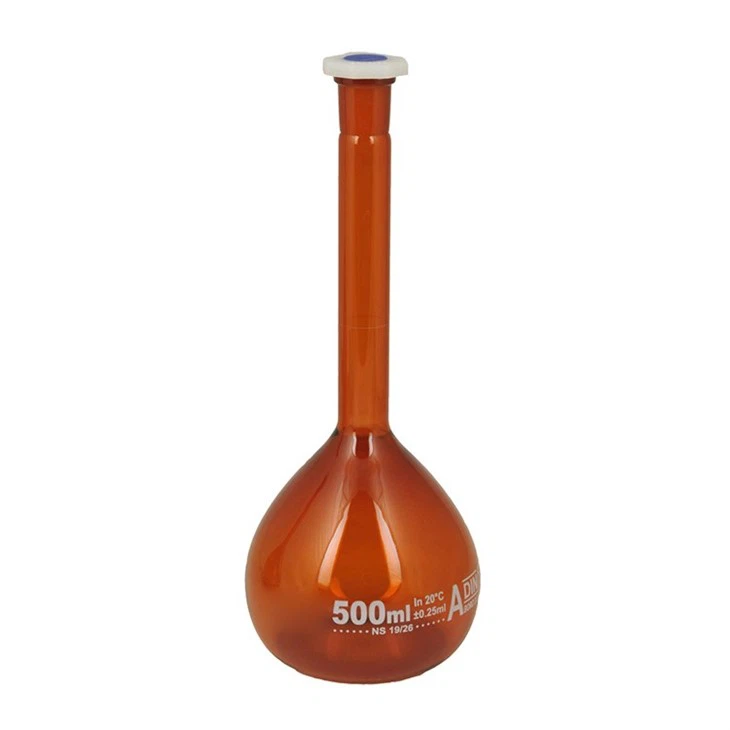
On the other hand, a volumetric flask is designed for one specific purpose: to hold a very precise volume of liquid at a particular temperature. It has a narrow neck and a bulb - shaped body, and it's marked with a single line that indicates the exact volume it's calibrated to hold. Volumetric flasks come in different sizes too, like the Lab 5ml 25ml 50ml Amber Glass Volumetric Flask with Stopper and the Laboratory Large Graduated 1000ml 2000ml Glass Volumetric Flasks with Plastic Or Glass Stopper.
Now, let's talk about precision. Precision in a lab setting means how close repeated measurements are to each other. When you're measuring liquids, a precise tool will give you the same result every time you use it to measure the same volume.

Graduated cylinders have markings at regular intervals. The precision of a graduated cylinder depends on its size and the spacing of these markings. Smaller graduated cylinders tend to be more precise because the markings are closer together, allowing for more accurate readings. However, even the best - quality graduated cylinders have some degree of error. The meniscus (the curved surface of the liquid) can be a bit tricky to read accurately, and there's always a small margin of error when estimating between the markings.
Volumetric flasks, on the other hand, are designed for maximum precision. They're calibrated to contain a specific volume of liquid at a specific temperature (usually 20°C). The single calibration mark on the neck of the flask makes it very easy to measure the exact volume. You simply add the liquid until the bottom of the meniscus touches the calibration line. Since there's no need to estimate between markings, the potential for error is much lower.
Let's look at an example. Say you need to measure exactly 25 mL of a solution for an experiment. Using a graduated cylinder, you'd have to read the meniscus at the 25 mL mark. There's a chance you might misread it by a fraction of a milliliter, especially if the cylinder is dirty or if the lighting is poor. With a 25 mL volumetric flask, you just fill it up to the calibration line, and you can be confident that you have exactly 25 mL of the solution.
Another factor that affects precision is the shape of the container. The narrow neck of a volumetric flask reduces the surface area of the liquid, which means there's less evaporation and less chance of the liquid splashing out during filling. This helps to maintain the accuracy of the measurement. In contrast, the wider opening of a graduated cylinder makes it more prone to evaporation and splashing, which can lead to inaccurate measurements.
But it's not all black and white. There are situations where a graduated cylinder might be a better choice. If you need to measure a range of volumes quickly and don't require extreme precision, a graduated cylinder is more convenient. You can measure 10 mL, 20 mL, or any other volume within the range of the cylinder without having to switch to a different tool. Volumetric flasks, on the other hand, are limited to the specific volume they're calibrated for. So, if you need to measure multiple different volumes, you'd need to have several volumetric flasks on hand.
In addition, graduated cylinders are more durable and less expensive than volumetric flasks. They can withstand a bit more rough handling, and if you accidentally break one, it won't cost you as much to replace. Volumetric flasks are more delicate because of their narrow necks and precise calibration, so they need to be handled with care.
So, to answer the question: Is a volumetric flask more precise than a graduated cylinder? The short answer is yes. Volumetric flasks are designed for high - precision measurements and have a much lower margin of error compared to graduated cylinders. However, the choice between the two depends on your specific needs in the lab. If you need extreme precision for a single - volume measurement, a volumetric flask is the way to go. If you need to measure a range of volumes quickly and don't need the utmost precision, a graduated cylinder will do the job.
At our company, we understand the importance of having the right tools for the job. That's why we offer a wide range of high - quality volumetric flasks. Whether you need a small flask for a delicate experiment or a large one for bulk measurements, we've got you covered. Our flasks are made from high - quality glass and are carefully calibrated to ensure maximum precision.
If you're in the market for volumetric flasks or have any questions about our products, we'd love to hear from you. Feel free to reach out to us to discuss your specific requirements and start a procurement conversation. We're here to help you find the perfect lab equipment for your needs.
References
- Harris, D. C. (2010). Quantitative Chemical Analysis. W. H. Freeman and Company.
- Skoog, D. A., West, D. M., Holler, F. J., & Crouch, S. R. (2013). Fundamentals of Analytical Chemistry. Cengage Learning.