

Let's dive right into the topic of what the boiling point of a substance in a boiling glass flask is. As a supplier of boiling glass flasks, I've seen firsthand how these nifty pieces of lab equipment play a crucial role in all sorts of scientific experiments and processes.
First off, what exactly is a boiling point? Well, it's the temperature at which a liquid turns into a gas. You've probably seen water boiling in a pot on the stove. When it hits 100 degrees Celsius (or 212 degrees Fahrenheit) at sea - level, it starts bubbling and turning into steam. But the boiling point isn't the same for every substance. Different liquids have different boiling points based on their chemical properties.
For instance, ethanol, which is the alcohol in alcoholic drinks, boils at around 78.37 degrees Celsius. That's lower than water because ethanol molecules don't stick together as strongly as water molecules do. On the other hand, mercury, a liquid metal, has a super - high boiling point of about 356.73 degrees Celsius.
Now, let's talk about how the boiling glass flask comes into play. A good quality boiling glass flask is designed to withstand high temperatures. It needs to be able to handle the heat without cracking or breaking while the liquid inside is reaching its boiling point.
We offer a wide range of boiling glass flasks, like the Transparent Laboratory Boro 3.3 Glass Boiling Flask Round Botton. This flask is made of Boro 3.3 glass, which is known for its excellent thermal resistance. It can handle rapid temperature changes without shattering. That's super important when you're dealing with substances that are being heated to their boiling points.
Another great option is the Standard Ground Mouth Oblique Shape Glass Flask with 2 Necks. The two - neck design gives you more flexibility in your experiments. You can attach different equipment, like condensers or thermometers, to the necks while the substance is boiling. This allows for more complex setups, which are often required in advanced scientific research.
And then there's the Lab Glass Flasks Bottle Short Neck Standard Ground Mouth Eggplant Shape Flask. The eggplant shape is great for certain types of reactions. It provides a larger surface area for evaporation, which can be really useful when you're trying to separate substances based on their boiling points, a process called distillation.
When a substance is placed in a boiling glass flask, a few things happen. First, as you start heating the flask, the heat is transferred to the liquid inside. The molecules in the liquid start moving faster and faster. As the temperature rises, the vapor pressure of the liquid increases. The vapor pressure is the pressure exerted by the gas molecules above the liquid. When the vapor pressure equals the atmospheric pressure (the pressure of the air around us), the liquid starts to boil.
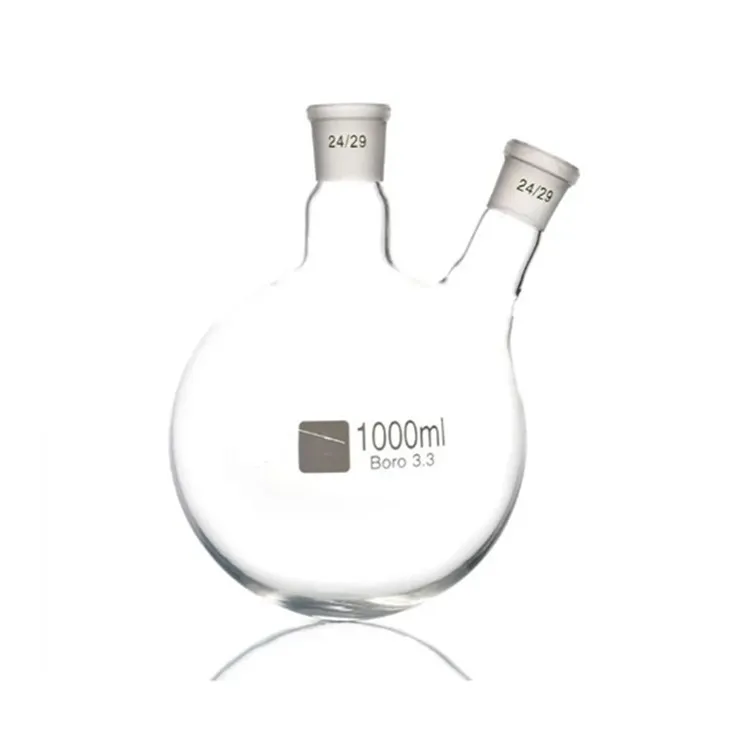

But it's not always that simple. The shape and material of the boiling glass flask can actually affect the boiling process. For example, a flask with a rough interior surface can provide nucleation sites. Nucleation sites are places where bubbles can form more easily. So, if your flask has a smooth interior, it might take a little longer for the liquid to start boiling because there aren't as many places for the bubbles to form.
Also, the thickness of the glass matters. A thicker glass flask will take longer to heat up, but it will also retain heat better. This can be an advantage in some experiments where you need a slow and steady heat source.
The altitude also plays a role in the boiling point of a substance in a boiling glass flask. At higher altitudes, the atmospheric pressure is lower. Since the boiling point is when the vapor pressure equals the atmospheric pressure, substances will boil at lower temperatures at high altitudes. For example, on top of a mountain, water will boil at a temperature lower than 100 degrees Celsius.
In a lab setting, scientists use boiling glass flasks to study all sorts of things. They might be trying to purify a substance by distillation. By heating a mixture in a boiling flask and collecting the vapor at different temperatures, they can separate out the different components based on their boiling points.
Or they could be studying chemical reactions that occur at high temperatures. The boiling glass flask provides a safe and controlled environment for these reactions to take place.
If you're in the market for high - quality boiling glass flasks for your lab or scientific project, we've got you covered. Our flasks are made to the highest standards, ensuring that they can handle the rigors of scientific experimentation. Whether you need a round - bottom flask for general heating or a multi - neck flask for more complex setups, we have the right product for you.
So, if you're interested in learning more about our boiling glass flasks or want to place an order, don't hesitate to reach out. We're here to help you with all your boiling glass flask needs and make sure you get the best products for your scientific endeavors.
References
- Atkins, P. W., & de Paula, J. (2014). Physical Chemistry. Oxford University Press.
- Chang, R. (2010). Chemistry. McGraw - Hill.