

When it comes to laboratory equipment, volumetric flasks and beakers are two commonly used items, each with its own unique features and functions. As a volumetric flask supplier, I often encounter questions from customers about the differences between these two pieces of labware. In this blog post, I'll delve into the key distinctions between volumetric flasks and beakers, helping you understand when to use each and how they can best serve your laboratory needs.
1. Design and Structure
One of the most obvious differences between volumetric flasks and beakers lies in their design and structure.
A volumetric flask is a piece of precision glassware. It typically has a pear - shaped body with a long, narrow neck and a flat bottom. The neck of a volumetric flask is calibrated to contain a specific volume of liquid at a particular temperature (usually 20°C or 25°C). There is a single calibration mark on the neck, which indicates the exact volume that the flask is designed to hold. For example, a 100 ml volumetric flask is designed to hold exactly 100 ml of liquid when filled up to the calibration mark. Volumetric flasks come in various sizes, from small ones like 5 ml to large ones such as 2000 ml. You can find our Lab 5ml 25ml 50ml Amber Glass Volumetric Flask with Stopper and Laboratory Large Graduated 1000ml 2000ml Glass Volumetric Flasks with Plastic Or Glass Stopper in our product range.
On the other hand, a beaker is a simple cylindrical container with a flat bottom and a lip for easy pouring. It usually has graduations on the side, which are approximate volume markings. These markings are not as precise as the single calibration mark on a volumetric flask. Beakers come in a wide range of sizes, from a few milliliters to several liters, and they are often used for general mixing, stirring, and holding of liquids in the laboratory.
2. Accuracy and Precision
Accuracy and precision are crucial factors in laboratory work, and this is where the difference between volumetric flasks and beakers becomes even more significant.
Volumetric flasks are designed for high - precision volume measurements. They are capable of delivering a very accurate volume of liquid. The accuracy of a volumetric flask is typically within ±0.1% - ±0.2% of the stated volume. This high level of accuracy makes volumetric flasks ideal for preparing standard solutions, where the exact concentration of a solute in a solvent is required. For instance, in analytical chemistry, when preparing a standard solution of a known molarity for titration experiments, a volumetric flask is the go - to choice.
Beakers, however, are not intended for precise volume measurements. The graduations on beakers are only approximate, and the accuracy of volume readings from a beaker is relatively low, usually within ±5% - ±10% of the stated volume. Beakers are more suitable for rough estimations of volume and for tasks where a high degree of precision is not necessary, such as mixing large volumes of reagents or heating liquids.
3. Function and Usage
The functions and typical usages of volumetric flasks and beakers also differ significantly.
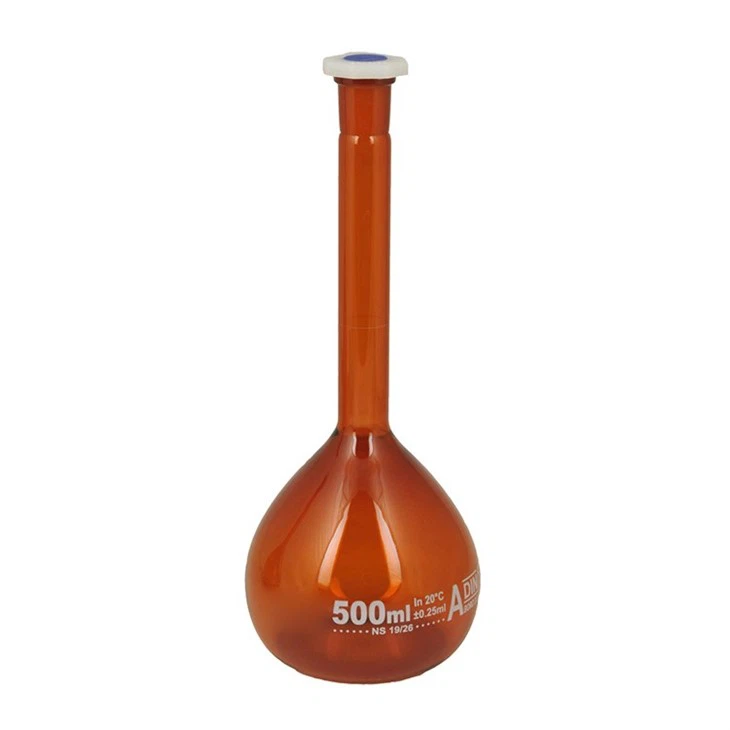

Volumetric flasks are mainly used for preparing solutions of a specific volume and concentration. To use a volumetric flask, you first add the solute to the flask, then add some solvent to dissolve the solute. After that, you carefully add more solvent until the bottom of the meniscus (the curved surface of the liquid) reaches the calibration mark on the neck of the flask. This ensures that the solution has the exact volume and concentration you desire. Volumetric flasks are commonly used in chemical analysis, pharmaceutical research, and other fields where accurate solution preparation is essential.
Beakers, with their wide range of applications, are a staple in any laboratory. They are used for mixing and stirring liquids, heating solutions on a hot plate or in a Bunsen burner flame (although beakers are not designed for high - temperature heating like some specialized glassware), and for holding and transferring liquids during various laboratory procedures. Beakers are also useful for collecting and temporarily storing liquids during experiments.
4. Material and Durability
Both volumetric flasks and beakers are commonly made of glass, usually borosilicate glass, which has good chemical resistance and thermal stability.
Volumetric flasks are made with high - quality glass to ensure the accuracy of volume measurements. The glass used in volumetric flasks is carefully crafted to have a uniform thickness and shape, which is essential for maintaining the accuracy of the calibration mark. However, volumetric flasks are relatively fragile due to their long, narrow necks. They need to be handled with care to avoid breakage.
Beakers are also made of borosilicate glass, but they are generally more robust than volumetric flasks. The cylindrical shape of beakers makes them less prone to breakage compared to the more delicate design of volumetric flasks. Beakers can withstand some rough handling during normal laboratory use, such as stirring with a glass rod or being moved around on the bench.
5. Cost
Cost is another factor to consider when choosing between volumetric flasks and beakers.
Volumetric flasks are more expensive than beakers. The high - precision manufacturing process, which includes accurate calibration and the use of high - quality glass, contributes to the higher cost of volumetric flasks. Additionally, the need for strict quality control to ensure the accuracy of volume measurements further adds to the cost.
Beakers, on the other hand, are relatively inexpensive. Their simple design and less demanding manufacturing process make them a cost - effective option for general laboratory use.
Conclusion
In summary, volumetric flasks and beakers are both important pieces of laboratory equipment, but they serve different purposes. Volumetric flasks are designed for high - precision volume measurements and are essential for preparing solutions of exact concentrations. They are more expensive and more fragile but offer a high level of accuracy. Beakers, on the other hand, are used for general mixing, stirring, and rough volume estimations. They are less expensive, more robust, and suitable for a wide range of general laboratory tasks.
If you are in need of high - quality volumetric flasks for your laboratory, we are here to provide you with the best products. Our volumetric flasks are manufactured to the highest standards, ensuring accurate volume measurements and long - term durability. Whether you need small - sized volumetric flasks for micro - scale experiments or large - sized ones for industrial applications, we have the right solution for you.
If you are interested in our volumetric flasks or have any questions about our products, please feel free to contact us for procurement and further discussions. We look forward to serving your laboratory needs.
References
- Harris, D. C. (2015). Quantitative Chemical Analysis. W. H. Freeman and Company.
- Skoog, D. A., West, D. M., Holler, F. J., & Crouch, S. R. (2014). Fundamentals of Analytical Chemistry. Cengage Learning.