



Product Description:
Laboratory biological microscope is used to observe and study biological slices, biological cells, bacteria, living tissue cultures, fluid sediments, etc. Trinocular microscope can also observe other transparent or translucent objects as well as powders, fine particles and other objects.
Product Specifications:
|
Model |
XSZ-BK2003 |
XSZ-BK5000 |
|
Eyepiece |
WF 10X/18mm |
WF 10X/20mm |
|
Objective |
Achromatic 4X,10X,40X (S),100X (S, OIL) |
Infinity Plan 4X,10X,40X (S),100X (S, OIL); Infinity Plan 20X (S) |
|
Viewing Head |
Binocular Head, Inclined 30°,Rotatable 360° ,Interpupillary Distance 48-75mm |
Trinocular Head, Inclined 30°,Rotatable 360° , Interpupillary Distance: 48-75mm |
|
Nosepiece |
Quadruple |
Quintuple |
|
Mechanical Stage |
Size: 145x140mm, Travel Range: 76x52mm Scale 0.1mm |
Size: 190x140mm,Travel Range: 78x55mm |
|
Condenser |
Abbe Condenser N.A 1.25 with Iris Diaphragm |
Abbe Condenser N.A 1.25 with Iris Diaphragm |
|
Focusing |
Coaxial Coarse and Fine Focusing Knobs Travel Range: 26mm, Scale: 2μm |
Coaxial Coarse and Fine Focusing Knobs Travel Range: 26mm, Scale: 2μm |
|
Illumination |
6V/20W Halogen Lamp |
Kohler Illumination 12V/20W Halogen Lamp |
Product Pictures:

How to use a trinocular biological microscope?
1. Take and place. When taking out the microscope from the microscope box, you must hold the arm of the microscope with one hand and the base of the microscope with the other hand to keep the microscope body upright. Do not tilt it with one hand to prevent the eyepiece from falling. Take and place it gently, with the arm of the microscope facing you, 5-10 cm away from the edge of the table. The table must be balanced, the desktop must be clean, and avoid direct sunlight.
2. Turn on the light source. Turn on the power switch.
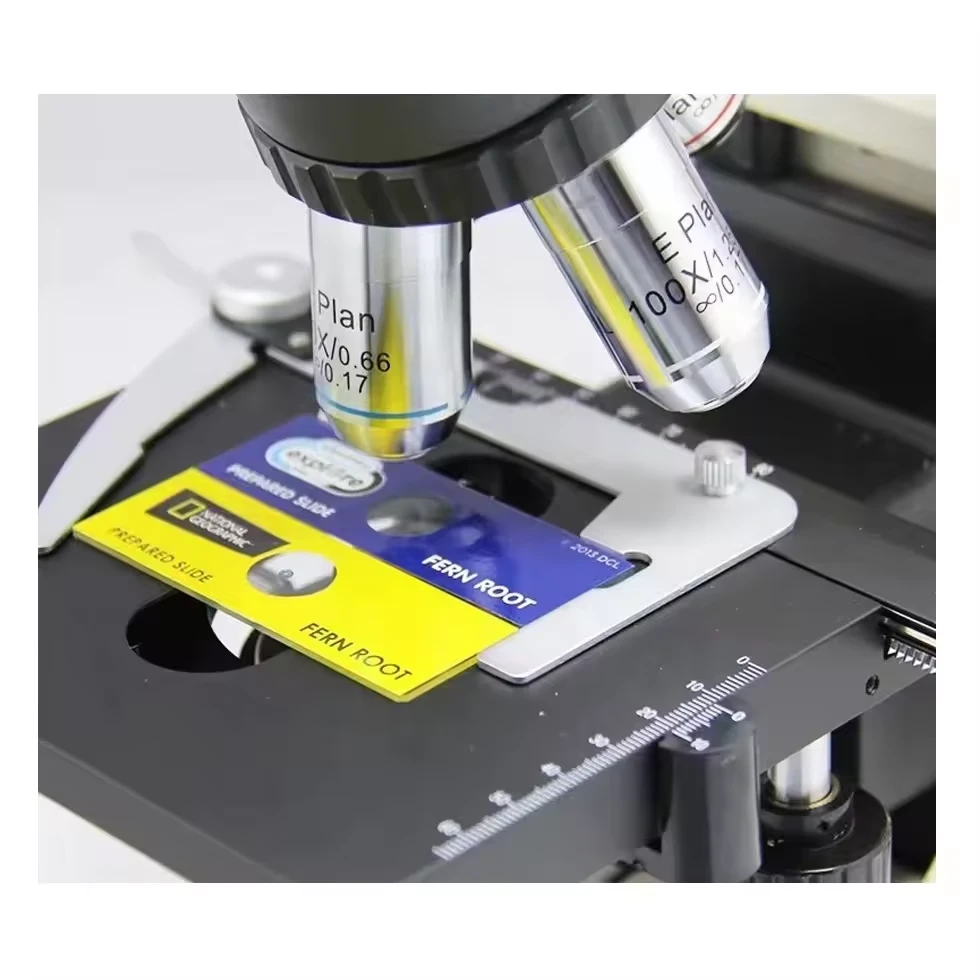
3. Place the slide specimen. Place the slide specimen to be examined on the moving table so that the material in it faces the center of the condenser. Then use the spring pressure plate to clamp the two ends of the slide to prevent the slide specimen from moving. Then adjust the slide mover or the moving table to move the material to the position facing the center of the condenser.
4. Observe with a low-power objective. When observing specimens with a microscope, you should first use a low-power objective to find the image. Because the low-power objective has a large observation range, it is easy to find the image and locate the part that needs to be carefully observed. The method is:
1) Turn the coarse focus knob, look from the side with your eyes, and lower the lens tube until the low-power objective lens is about 0.5 cm away from the specimen.
2) Observe through the eyepiece, slowly turn the coarse focus knob by hand, and gradually raise the lens tube until the image in the field of view is clear. After that, use the fine focus knob to slightly adjust the focal length to make the image clearest.
3) Fine-tune the moving stage or slide mover to find the part you want to observe. It should be noted that the image in the field of view of the microscope is usually an inverted image, and the slide should be moved in the opposite direction when moving.
5. High-power observation. On the basis of low-power observation, if you want to increase the magnification, you can observe at a high power. The method is:
1) Move the part you want to observe to the center of the low-power lens field of view, and the image should be clear.
2) Rotate the objective lens converter to move the high-power objective lens to the correct position, and then slightly adjust the fine focus knob to make the image clear.
3) Fine-tune the moving stage or slide mover to locate the part you want to observe carefully.
Note: When using a high-power objective lens, the distance between the objective lens and the specimen is very close, so the coarse focus knob cannot be moved, and only the fine focus knob can be used.
6. Change the slide. After the observation, if you need to change to another slide, turn the objective lens back to low power, take out the slide, and then replace the new slide. Focus slightly and you can observe. Changing the slide under a high-power objective lens is not allowed to prevent damage to the lens.
Hot Tags: laboratory trinocular biological microscope, China laboratory trinocular biological microscope manufacturers, factory, Glassware Burette Stopcocks, Glass 10ml 25ml 50ml 100ml Acid Burette With Straight Stopcock in Lab, Lab 5ml volumetric flask, Conical Shap Iodine Flask, Crystallizing Dish With Spout, Desiccator with ground


